Impressionists, the Hamburger Menu, and Vibe Coding
How Joke Names Go Official
It starts with a nickname from a design class: Many names we use quite seriously today began as something someone said in passing.
About 4,600 words, 8 images, 19 minutes to read.
The first time I heard hamburger menu was in a web design class. My teacher pointed to the three horizontal lines in the corner of the screen and simply called them a hamburger menu. There was no explanation, and we all accepted it straight away.
Only later did I realize what makes names like this so effective: We know they are a little silly and not quite accurate, yet everyone knows which thing we mean.
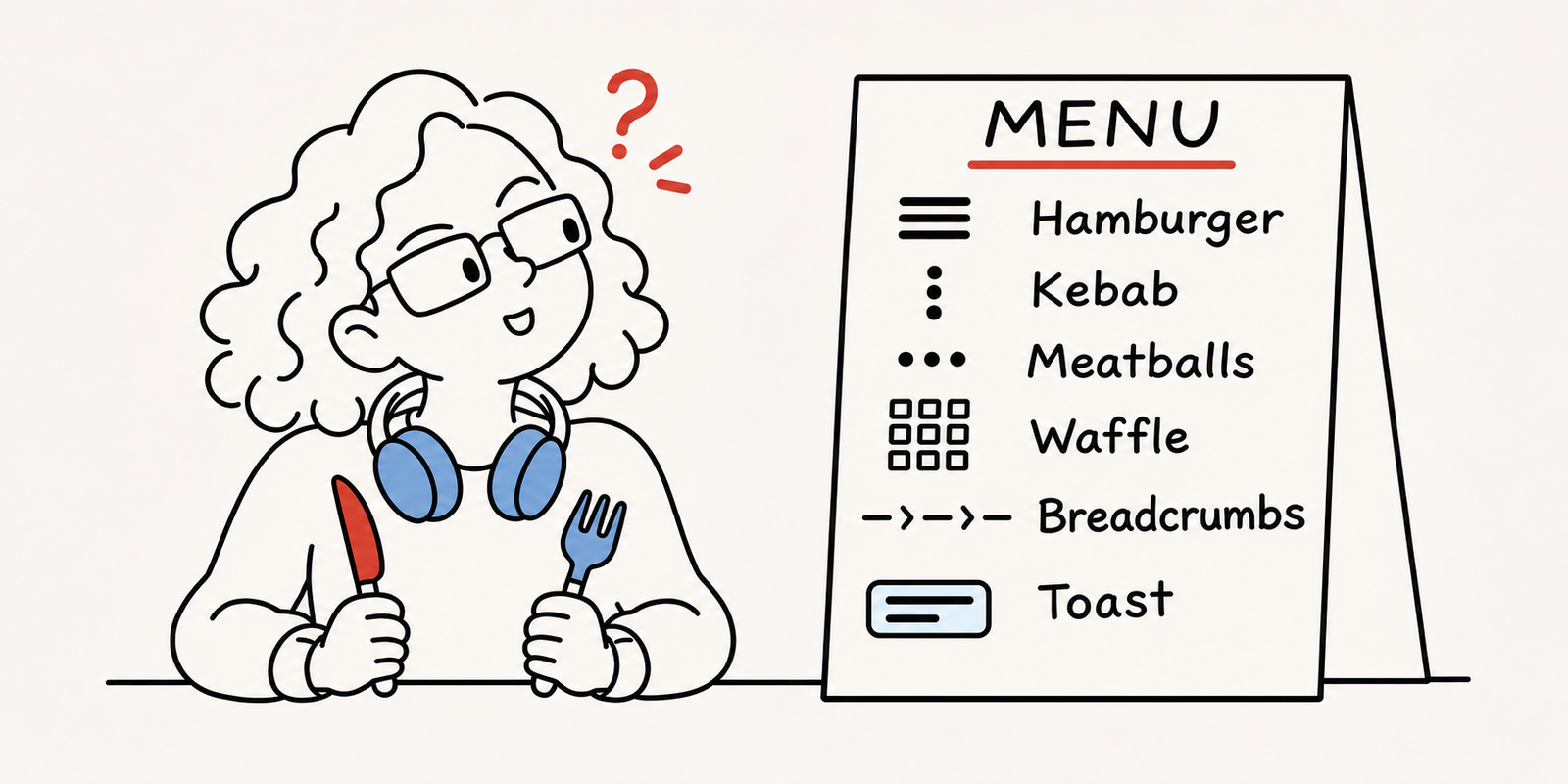
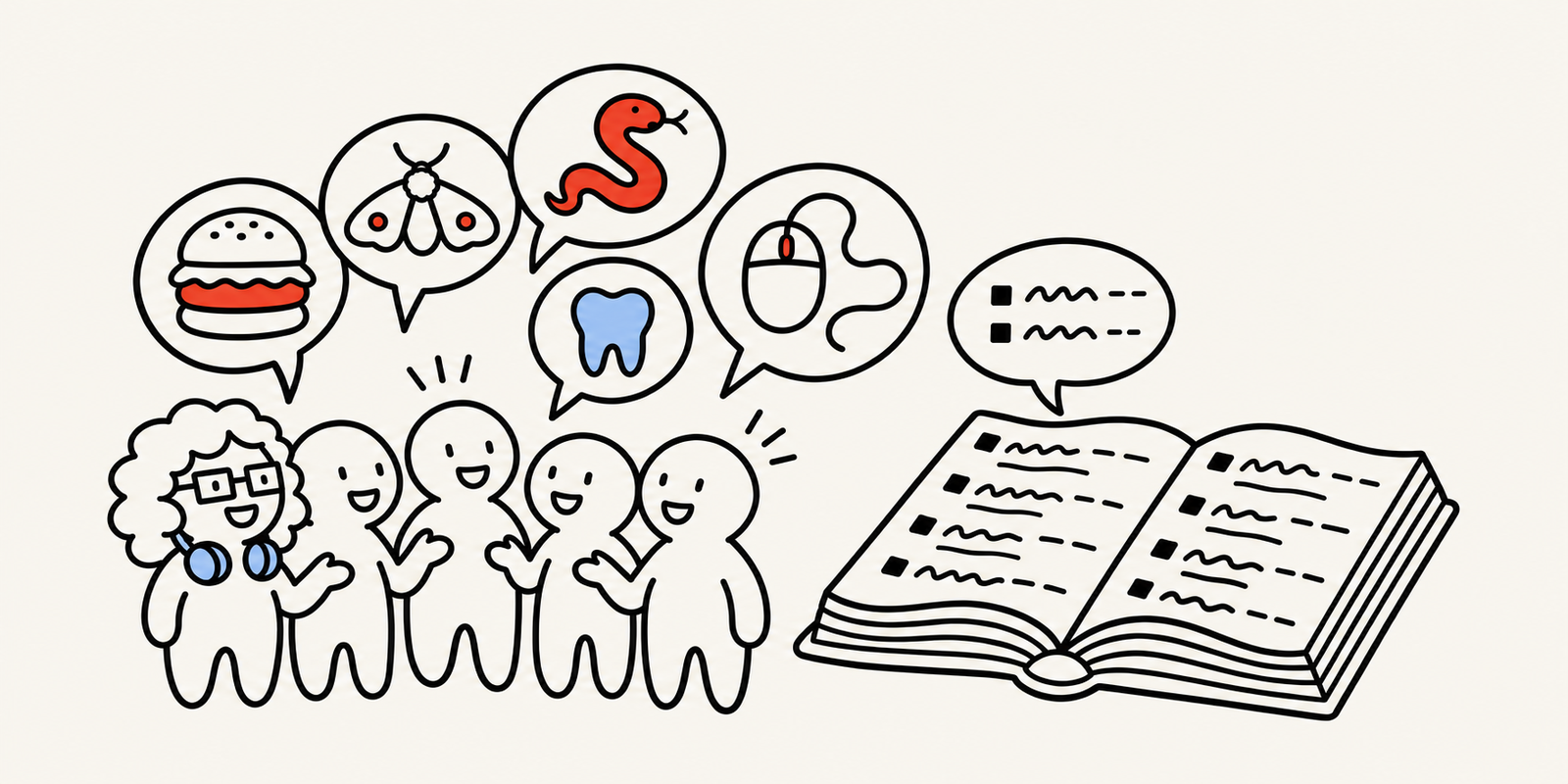
When showing someone an interface, I also didn't want to keep saying “the three horizontal dots” or “the three vertical dots.” To me, they were all buttons you clicked to see more things. I wasn't sure whether each had its own name, so I asked AI. It came back with a list that read like a restaurant menu: hamburger, meatballs, kebab, bento, and waffle. When I looked at the icons again with those names in mind, it felt a bit like learning where someone's nickname came from. Once you see it, it's hard to forget.
The official names are another matter, though. Design systems say things like menu, more button, and app launcher. The food names are mostly what designers and programmers call them in conversation, and even then, not everyone uses them. I only meant to find out what to call a few buttons. As I kept looking, I found that some nicknames had made it into the guidelines.
Outside design, names like this are everywhere. Some, like code monkey, have made it into dictionaries but still carry an “informal” label. Others, like hamburger, cookie, and, more recently, vibe coding, have found their way into design systems, dictionaries, or even the law. The odd part is that names chosen with great care often lose out to these casual nicknames.
1Design systems disagree, but we keep saying hamburger
Different design systems give the same button different names. In conversation, though, designers and programmers keep ordering from the same menu. The food names work because they give us a picture straight away, while the official names take a moment to work out.
The names people actually use
Take the three-dot “more” button. Google's guidelines call it an overflow menu, while Apple's call it a More pull-down button. For the three horizontal lines, Microsoft's guidelines actually say “Hamburger icon.” Judging by the names alone, you might think they were talking about different things.

Three horizontal dots are meatballs. Turn them upright, and they become a kebab. Some people call a three-by-three grid a bento; others call it a waffle. A message that pops up and disappears after a while is a toast. Some of these are already official terms; others are still nicknames, so this menu of names is only half official. The figure above shows what each design system calls them.
The icon has an author; the nickname doesn't
Of all these names, hamburger is the one that made me want to dig deeper. In 1981, Xerox, the company best known for its photocopiers, launched the Star workstation, one of the first commercial computers with a graphical interface: windows, icons, and a mouse. Designer Norm Cox drew those three horizontal lines for it, more than 20 years before the iPhone. With phones so familiar now, it's easy to assume the icon was invented to save space on a phone screen. It was already there long before that.
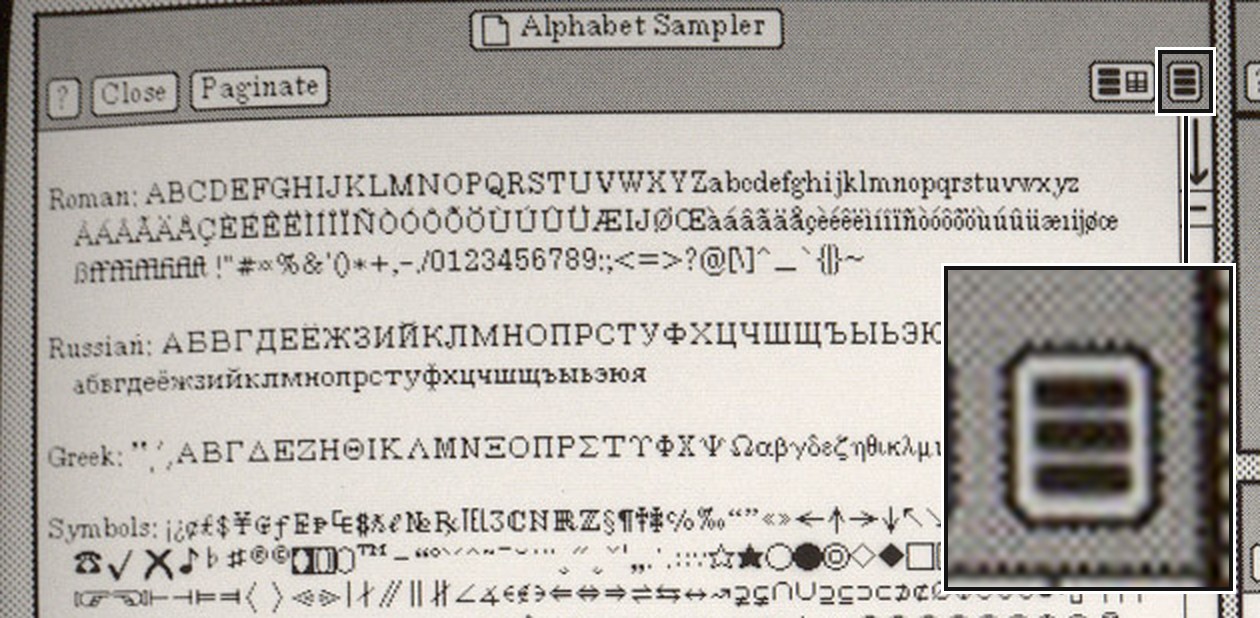
On its own, the icon is just three short lines stacked one above another. There is very little to it. It doesn't spell out the word menu, and it doesn't actually draw a hamburger. But the top and bottom lines look like bread, with a filling in between. Once someone calls it a hamburger, your eyes finish making the meal. Cox drew an icon. People later gave it an image they could easily put into words, and the two came together.
The trail went cold at exactly the point I cared about most. I could find out who drew the icon, but not who first called it a hamburger. Even Cox only heard the nickname later. We know the designer's name; the person who named the hamburger left no name behind. Yet the nickname kept spreading. It feels less like someone declaring “This is what we'll call it” and more like someone saying it in passing, with the people nearby deciding it fit. School nicknames work the same way: Most of us can't say who came up with ours. I'll come back to this in the last chapter.
I even suspect that hamburger came first and the other food names followed. If three lines can be a hamburger, why can't three dots be meatballs, or a vertical row be a kebab? The early uses I found roughly fit that order, but that doesn't prove a connection, so this is only my guess. What I can say is that once you've heard the nicknames, recognizing the icons takes much less explanation.
Some nicknames are already on the record
Some nicknames already have an official record. The coloured cells in Fig. 1 show where design systems use the nicknames themselves. In 2022, Dictionary.com also added hamburger menu and kebab menu.
Breadcrumbs took a more direct route: That is the official name. It comes from the trail of crumbs the children leave in the Grimm fairy tale Hansel and Gretel. The empty little boxes that appear when a character is missing are called tofu. Google even named a font family Noto, from “no more tofu.” True to this chapter's pattern, the two companies behind its Chinese, Japanese, and Korean (CJK) fonts couldn't settle on one name either: Google calls them Noto, and Adobe releases the same designs as Source Han.
One name made it all the way into law. In 1994, Netscape engineer Lou Montulli borrowed the older programming term magic cookie to name a small piece of data. The word later entered European Union legislation and became the “Accept cookies” we click every day.
Short names that bring a picture to mind save a lot of explaining. Food isn't the only source. Design systems also have accordions, drawers, and carousels, all borrowed from everyday life.
2Many official terms began as something less serious
Designers are hardly alone in this. Many terms used officially in serious fields had rather unserious beginnings. Some even started as insults.
Names people started using among themselves
The best-known example is the computer mouse.
In the 1960s, Douglas Engelbart and Bill English made a small wooden box by hand at the Stanford Research Institute. Put today's mouse aside for a moment. This one had two wheels underneath, set at right angles to each other, and a cord trailing behind it. The box was the body, and the cord was the tail. The team called it a mouse.
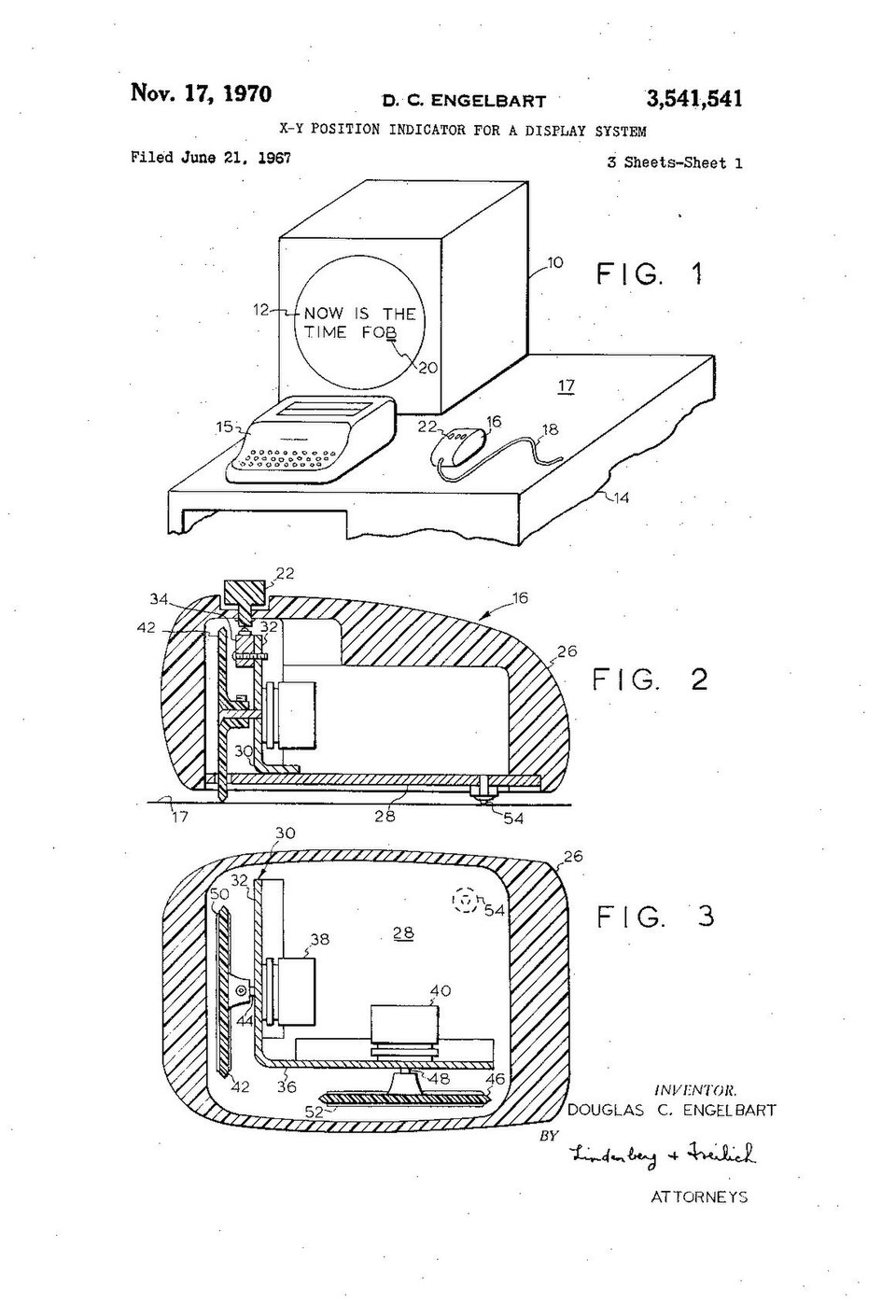
“A small wooden box” could mean almost anything. Add the cord, and a mouse appears. You didn't need to explain how the wheels underneath worked for someone nearby to know which object you meant.
But when you ask who first said it, we are back with the hamburger. Engelbart later recalled that no one remembered. It simply looked like a mouse with a tail. His answer is a little funny and very practical. People remembered why it looked like a mouse, but not who first noticed.
By the time they submitted a report to NASA in 1965, it was already called a mouse. A nickname used around the team had entered a document meant for people outside it. Today's mice have mostly lost the cord, but the name stayed.
Code names, slang, and jokes that stayed
Some names began as a way to hide things. During the First World War, Britain secretly developed a new vehicle under the cover of making water tanks. The code name was tank. According to one participant's later account, an earlier suggestion was “Water Carrier”; shortened, that would have been W.C., meaning a toilet, so they settled on tank. The code name became the official term.
Bug is the story most people already know. In 1947, workers on Harvard's Mark II computer taped a moth into the logbook and noted that they had found an actual bug. The joke only worked because the word was already in use: Edison was writing about “bugs” as early as 1878.
Technical slang gives people in a field a shared shorthand. Once you can use it easily, you don't have to explain everything from the beginning. Unwanted messages became spam, and a programming language became Python. Both names came from the British comedy group Monty Python. In 1986, The Economist introduced the Big Mac Index as a “lighthearted” guide. Forty years later, it still turns up in economics classes.
The Waffle House Index is generally traced to Craig Fugate in 2004, when he was Florida's head of emergency management: He used the breakfast chain's status to judge conditions after a disaster, with green for a full menu, yellow for a limited menu, and red for closed. It is an informal indicator of conditions on the ground, rather than an official disaster rating.
In 2025, it was vibe coding's turn
The fastest recent promotion may be vibe coding. In February 2025, Andrej Karpathy, one of OpenAI's founding members, wrote a half-joking post about “a new kind of coding I call ‘vibe coding’”: You tell AI what you want, let it write the code, and hardly look at the code at all. It was, he said, “not too bad for throwaway weekend projects.” By November, Collins Dictionary had named it its Word of the Year, and Microsoft's official training site now offers a course called “Introduction to vibe coding.”
Of course, a name catching on doesn't guarantee it a place in an official document. Code monkey is familiar enough to be in the dictionary, and programmers use it to make fun of themselves. Yet it is still labelled “informal”; nobody would put it in a job ad.
Insults people adopted for themselves
Another route is a little harsher. Someone uses a name to mock you; you take it up and keep using it, sometimes quite happily. The most famous example is Impressionism.
In the spring of 1874, Monet, Renoir, Pissarro, and other painters who were not welcome at the official Salon put on their own exhibition in a borrowed photography studio in Paris. Manet, whose name differs from Monet's by just one letter, was not among them. He never took part in any of the group's eight exhibitions. Monet had painted a sunrise over the harbour at Le Havre. As he later recalled, someone preparing the catalogue asked him for a title. He replied, “Put down: Impression.” The painting became Impression, Sunrise.
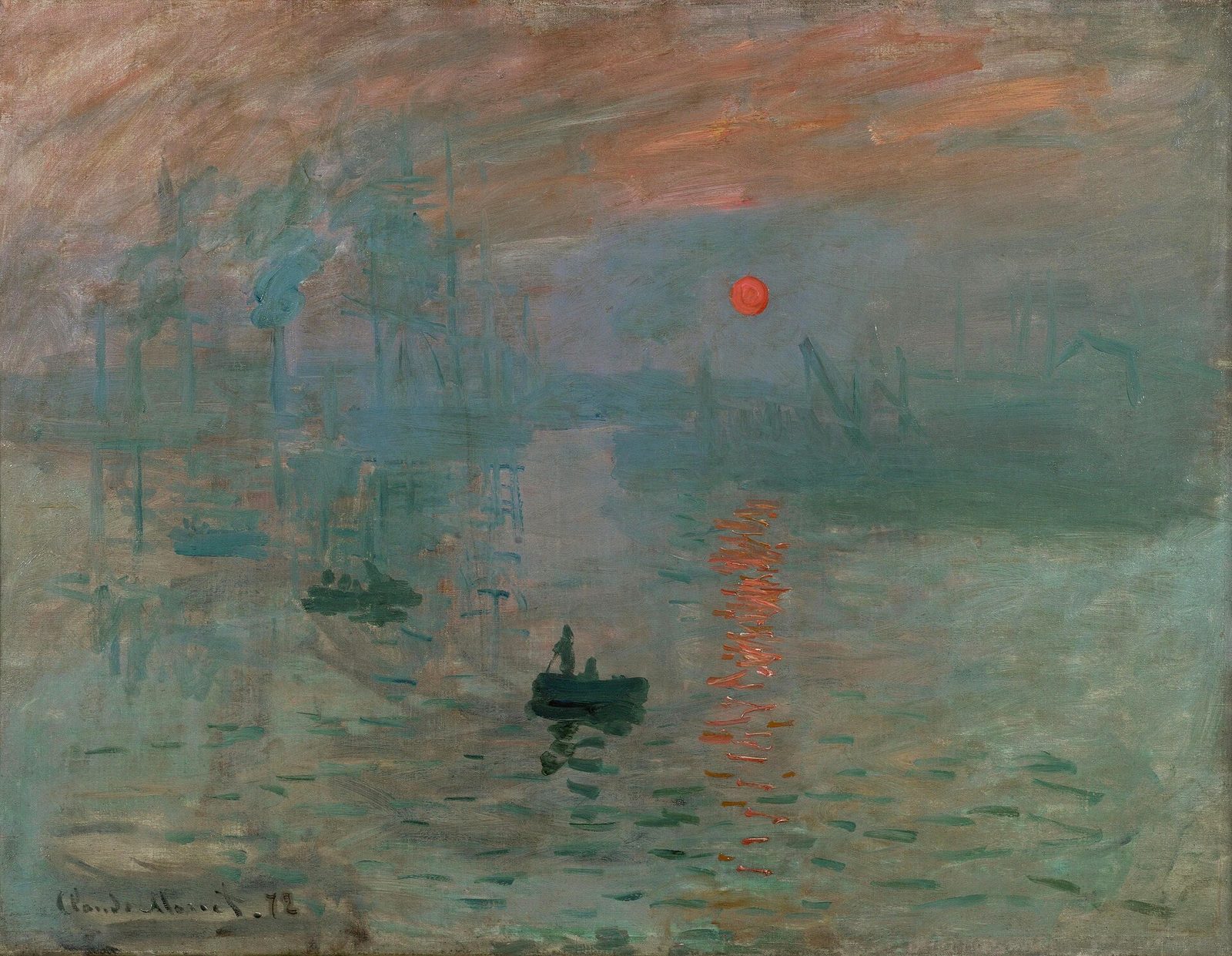
Louis Leroy, a critic writing for a satirical newspaper, mocked the show in an article titled The Exhibition of the Impressionists. Through the voice of an old-fashioned painter, he suggested that even wallpaper in its earliest stages was more finished than this seascape. What bothered him was how unfinished it looked. He took the word impression from the painting's title and turned it into a fault the whole group shared.
Three years later, at their third exhibition in 1877, the painters called themselves Impressionists. A word meant to ridicule them had become their name. In 2024, 150 years after the first exhibition, the Musée d'Orsay devoted a major show to that event in 1874. Today, hardly anyone remembers that Impressionist began as an insult.
The critic Louis Vauxcelles contributed to two similar names. At the 1905 Autumn Salon, he saw a classical-looking sculpture in a room full of paintings in strong reds and greens, and wrote that it was like Donatello, the Renaissance sculptor, among “wild beasts.” The French for wild beasts is fauves, and that gave us Fauvism. In 1908, he mocked the painter Georges Braque for reducing everything to cubes, helping give us Cubism.
The same thing happened outside art
In 1906, Britain's Daily Mail used suffragette to mock militant women campaigning for the vote. The ending -ette suggested something small. In 1912, the women made it the name of their own newspaper, The Suffragette.
The most everyday example is Black Friday. By at least the early 1960s, Philadelphia police were using that name for the day after Thanksgiving: traffic jams, shoplifting, and overtime for everyone. Retailers disliked it and tried to rename the day Big Friday, without success. The now-familiar story about accounts moving from red to black came later, and the name stayed.
The meaning of a word changes with who is using it and whether they mean it as an insult or a name to accept. Linguists call a move from a negative meaning towards a more positive one amelioration. A term may be absent from official documents for a while and still be alive in conversation. Given enough time, it can find its way onto the page.

3But carefully chosen names often lose to casual ones
Programmers have a joke that is usually credited to Phil Karlton, an engineer at Netscape: “There are only two hard things in Computer Science: cache invalidation and naming things.” Naming is hard enough, and even a name chosen with care may not catch on. That happened with Bluetooth.
Bluetooth began as a code name
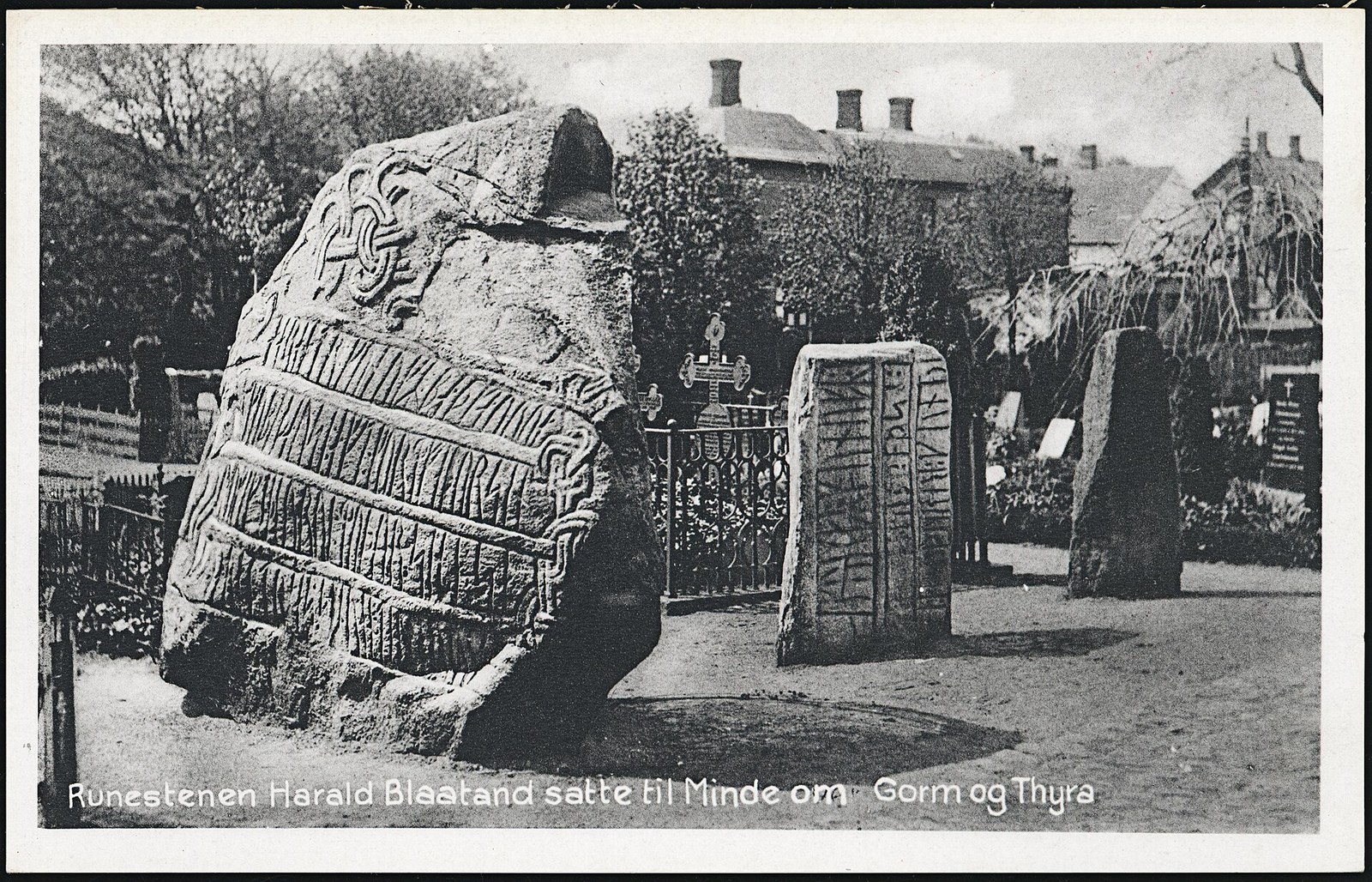
In the late 1990s, Intel, Ericsson, and Nokia were working on a short-range wireless technology. Intel engineer Jim Kardach needed a code name for it. He had recently read a book about Vikings, including a 10th-century Danish king, Harald, nicknamed Bluetooth, who had united Denmark and Norway.
The king in the book and the wireless technology in front of him seemed far apart. But Kardach saw a connection. The king had brought two lands together; this technology was meant to bring together the computer and mobile phone industries. It sounded like someone's nickname because that was exactly what it was.
Bluetooth was only supposed to be temporary. There were plans for a proper name. The leading candidate was PAN, short for Personal Area Networking, a clear description. But a search turned up tens of thousands of results for the same name. The trademark search for another candidate, RadioWire, couldn't be completed before the launch. Neither planned name made it, and by then Bluetooth was already familiar across the industry. It was too late to change. The king is still in the logo today, which combines the runic initials of Harald and Bluetooth.
The mouse also had a very orderly official name. Its patent called it an “X-Y position indicator for a display system.” That explained its purpose perfectly well. But if you were looking for one on a desk, mouse was enough. The long name suited a patent. In everyday conversation, it took too much saying.
Why Esperanto never caught on
Perhaps the most serious attempt was Esperanto. In 1887, someone deliberately designed a language with regular rules, hoping it would become a common language for the world. More than a century later, it still hasn't become widely used.
Jun Wu once argued that the small number of learners was only the surface problem. The deeper issue, in his view, was that Esperanto had no culture. Language carries information and culture together, and getting the rules in order may not be enough to persuade people to change how they speak. (Wu joined Google in 2002, two years before its IPO, and was the main designer of its CJK search algorithms. He later served as a vice president at Tencent.) Hebrew makes the opposite case. After more than a thousand years without everyday speakers, it was revived as a spoken language in the late 1800s, and that was possible because the culture behind it was still there.
What makes a name catch on
People choosing a name want it to be accurate and complete. People saying it want something else, a name they can:
- remember easily,
- say easily, and
- understand at once.
The nicknames we've seen happen to offer all three advantages. Let's take them one at a time.
Easy to remember
Say meatballs, and the three dots are already lined up in your mind. Psychologists call this dual coding: Concrete words tend to call up both the word and a picture in the mind, while abstract words rely mostly on the word alone, so concrete words are often easier to remember. Meatballs, hamburgers, and mice all give us a picture as soon as we hear them.
In Heartwarming, a social psychologist discusses embodied cognition: We carry physical sensations into abstract judgments, which is why a person can be warm or cold. A study of 94 languages found that 46 used warmth to describe closeness. Two famous experiments once seemed to show how far this goes: People who had just held a cup of hot coffee rated a stranger as warmer, and people holding a heavy clipboard treated a question as more important. Later, larger replication studies failed to reproduce these effects. The language habit has stayed with us, though. We also borrow between senses in everyday English: A shirt can be loud and a cheese can be sharp.
Being funny helps too. A 1994 experiment found that humorous sentences were easier to remember than nonhumorous ones, especially when the two kinds appeared together. When your days are full of requirements, schedules, reviews, and alignment meetings, a meatball is hard to forget.
One caveat, though: Whether a phrase brings a picture to mind depends on when you hear it. Many old sayings were once as vivid as meatballs is today. Over time, the picture fades, and the words themselves become an obstacle. “The proof is in the pudding” is short for “The proof of the pudding is in the eating”; proof here means a test. In just deserts, deserts means what someone deserves, an old meaning that now often gets mistaken for desserts.
Easy to say
A name has to stand up to daily use. People can manage an explanation once. Having to say the full term every time is more work. There is nothing wrong with “X-Y position indicator, blah, blah, blah.” But by the time you finish saying it, the person beside you has already said mouse.
People tend to save effort when they speak. The linguist George Zipf observed that more frequently used words tend to be shorter. He later brought tendencies like this together under the principle of least effort. Mouse has just one syllable. A short name saves you from explaining its function every time. When a name takes less effort to say and is easy for the listener to follow, people are more likely to use it again.
Easy to understand at once
My boss, the founder of Superlinear Academy, who goes by Kedaibiao, once wrote in a post titled Nouns, Verbs, and Craft (title translated):
Naming doesn't make Craft simple. Naming makes Craft visible.
Once something has a name, we can point to it, and other people can see it too. Before hamburger, you had to say “those three lines in the corner” and hope the other person was looking at the same spot. After it, one word does the pointing. A nickname gets there fastest because it describes what is in front of you: a wooden box with a tail, or three lines with a filling in the middle. If you've seen the shape, the name finds it straight away.
AI has words like this too. When a model confidently makes up papers or books that don't exist, we say it is hallucinating. Geoffrey Hinton, often called the godfather of AI, has argued that this is the wrong word and that it should be called confabulation: Hallucination is about the senses, and the model isn't perceiving anything. What it does is closer to what doctors call confabulation, filling gaps in memory with made-up details. That may well be more accurate, but confabulation needs explaining, while everyone understands “The AI is hallucinating again.” In 2023, Cambridge Dictionary named hallucinate its Word of the Year.
Nicknames are also understood at once because they carry their stories with them. Say Impressionism, and that photography studio comes along; say Bluetooth, and so does the king. Looking back at Esperanto, I prefer to read “no culture” this way: What it lacked was the things a group of people had named together and remembered together.
4Names can be wrong, but nicknames can't
A line you often hear in Chinese says that names can be wrong, but nicknames can't. Nicknames come from people who deal with something every day, which is why they fit. The same can happen with nicknames for people: Nobody needs to be told what a Karen is. Put simply, a name is made by the people who use it, not by the person who picks it. An official document can give a nickname a formal place, but long before that, it has already found a place in many conversations.
Even the pronunciation isn't up to the inventor
Even the way a name is pronounced may be beyond its creator's control. In 2013, GIF inventor Steve Wilhite received a Webby lifetime achievement award. Acceptance speeches were limited to five words, so he put his five on the screen: “It's pronounced 'Jif,' not 'Gif.'” Yet many people kept using a hard g. In Stack Overflow's 2017 developer survey, nearly 2 in 3 respondents chose the hard g, while just over 1 in 4 chose the soft one. The Oxford Advanced Learner's Dictionary and Merriam-Webster include both pronunciations. Inventing something and deciding how everyone will say its name turn out to be separate jobs.
The pronunciation taught at school isn't fixed either
Language itself keeps changing, and pronunciation shows it. At school in China, each word was treated as having one correct pronunciation, much like the British idea of “proper English”: That was simply how you were supposed to say it. In middle school and high school, I lost count of how many times I was corrected. English class worked the same way. I first learned British English. Partway through, as people had more contact with North America, everyone switched to American English, and teachers began correcting us in the other direction. Either way, only one pronunciation counted.
Yet plenty of everyday words have two. Americans say mobile to rhyme with noble, while the British rhyme it with smile. Tomato has a long a on one side of the Atlantic and an ah on the other. Even the t in often can be said or left out. As Merriam-Webster puts it, “this dictionary reports both pronunciations as equally accepted.” The single proper way I was taught was more of a habit than a rule.
Nicknames benefit from the same kind of habit. A good one is so easy to remember and so plainly right that it stops sounding like a joke, and nobody thinks to look up the official name. Hardly anyone today hears mouse as a nickname. Sometimes the crowd's version even replaces the real one in memory, the so-called Mandela effect: Plenty of people are sure the children's books were The Berenstein Bears, though the series has always been The Berenstain Bears.
Every so often, someone complains that people can no longer speak properly. In 1712, Swift called English “extremely imperfect” in A Proposal for Correcting, Improving and Ascertaining the English Tongue and wanted it fixed forever. More than 40 years later, in the preface to his 1755 A Dictionary of the English Language, Johnson admitted it could not be done: “To enchain syllables, and to lash the wind, are equally the undertakings of pride.” Language follows the people who speak it. Going further would take another post.
Back to design: Listen to what people call it
Back in design, which was all I cared about at the start, I can draw one small conclusion for now: What users call something often matters more than the name we choose for it. Jakob Nielsen's 10 Usability Heuristics for User Interface Design puts it this way: “The design should speak the users' language.” When a name makes sense to users at a glance and in conversation, it deserves a hearing when we write the guidelines.
Naming what you make
This isn't only about design. Naming is no different from any other kind of creative work. Whether you are raising a child, writing an essay, or painting a picture, you start out like a parent, with your own ideas and expectations, including how you hope readers or viewers will feel. But once the work is out in the world, it rarely lands the way you planned. When you finish, your part as the author is over. That is only the beginning, though: The work is half done, and the other half belongs to readers, viewers, and everyone else.
The novelist Joseph Conrad said as much in a letter to a friend in 1897: “One writes only half the book; the other half is with the reader.” In 1957, the artist Marcel Duchamp said of art that “the creative act is not performed by the artist alone.”
Names work the same way. Whether you're naming a product, a feature, a newsletter, or a community, you can't decide what everyone will end up calling it. What you can do is choose something easy to say, notice what people actually call it, and keep the nickname if it sticks. In 1914, Coca-Cola ran newspaper ads that read, “Demand the genuine by full name; nicknames encourage substitution.” By 1945, it had registered Coke as a trademark. Pushing people to switch rarely works: Twitter became X in 2023, yet years later, news reports still add that it was formerly known as Twitter.
An answer from over 2,000 years ago: usage decides
People were already arguing about this in ancient Athens. In Plato's dialogue Cratylus, Cratylus holds that every thing has a name that is correct by nature. Hermogenes disagrees: “I think no name belongs to any particular thing by nature, but only by the habit and custom of those who employ it and who established the usage.” Socrates questions them both, and the dialogue never quite settles it. Aristotle, Plato's student, came down on the side of custom. In On Interpretation, he defined a noun as “a sound significant by convention” and added that “nothing is by nature a noun or name.”
Horace, writing in Rome around 10 BCE, went a step further in his Art of Poetry. Many words that have fallen out of use will be born again, he wrote, and many now in favour will fall, if usage wills it, because usage holds the judgement, the right, and the rule of speech. More than 1,700 years before Swift tried to fix English in place, Horace had already given the last word to the people who speak.
Nearly 2,000 years after Horace, the philosopher Ludwig Wittgenstein put it this way: “The meaning of a word is its use in the language.” If enough people keep using a name, it counts. In Sapiens, Yuval Noah Harari argues that humans can cooperate in large numbers because they share beliefs in things like companies and money. A name rests on the same kind of agreement, only much smaller: As long as everyone goes along with it, three lines are a hamburger.
So the next time someone gives something a silly nickname, don't rush to correct them. A few years later, everyone may have forgotten the official name and remember only that nickname.
Has a nickname around you quietly made it into the official documents yet?
Updates
- Added section headings; the three qualities in Part 3 now sit under "What makes a name catch on".
- Added three figures: the Xerox window header, a postcard of the Jelling stones, and the first page of Engelbart's patent.